Emoji Combos vs Kaomoji vs Text Symbols: A Quick Decoder
Emoji combos vs kaomoji vs text symbols, plainly — what each one is, when to use which, and how to mix them, with copy-ready examples for bios.
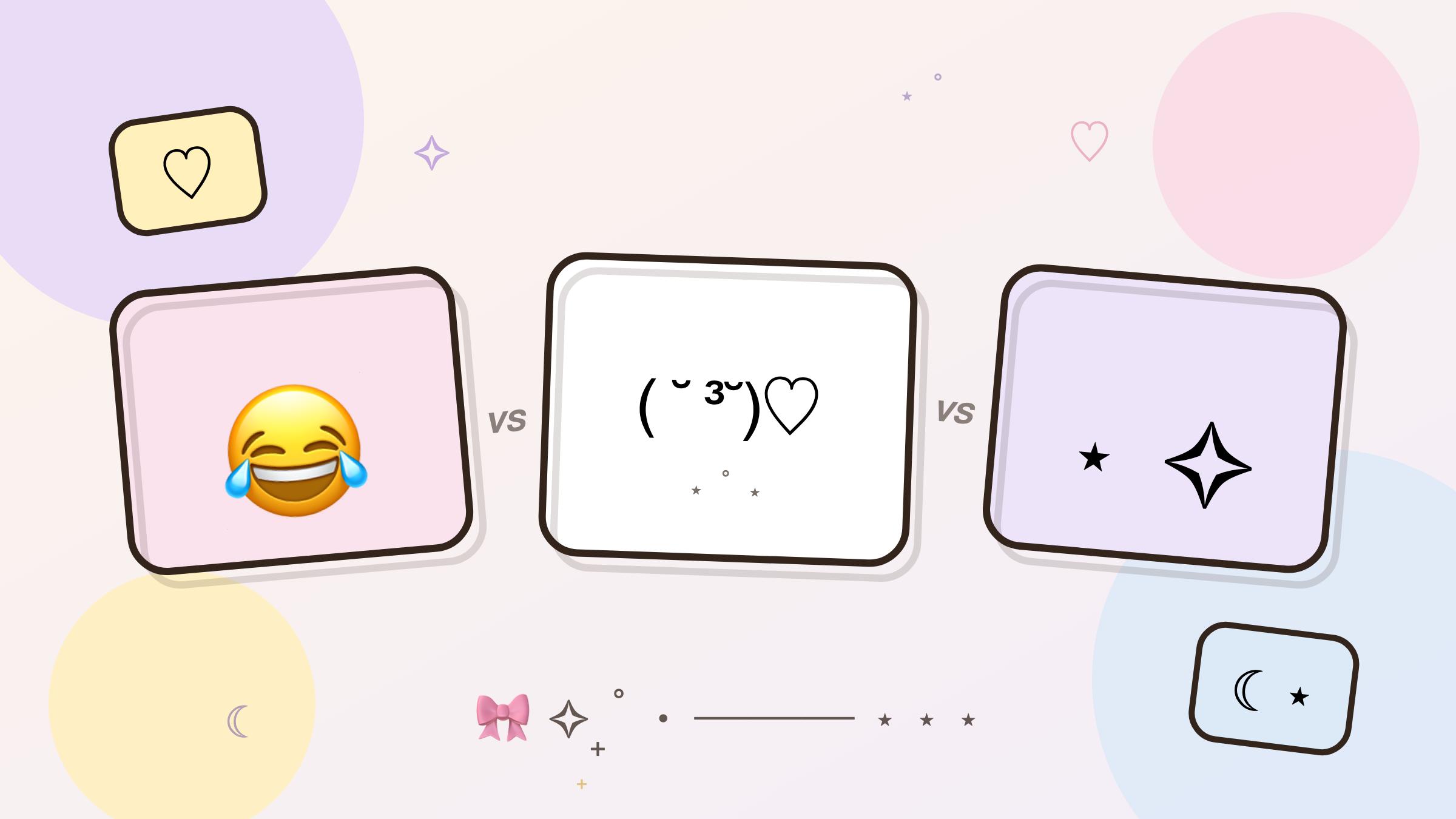
The one-sentence decoder
Emoji combos are short strings of real Unicode emoji mixed with decorative symbols — 🎀 ✧₊˚ or 🌙 📚 ☕. Kaomoji are faces built entirely from ordinary keyboard characters, like ( ˘ ³˘)♡ — no emoji inside. Text symbols are the single decorative characters themselves — ⋆ ✧ ♡ ☾ — the raw material the other two draw on.
That is the whole distinction: a combo paints a tiny scene, a kaomoji pulls a face, and a symbol adds the sparkle between them. The rest of this guide makes it practical — where each name comes from, five representatives of each, and how to mix all three without making noise.
The differences at a glance
| Emoji combos | Kaomoji | Text symbols | |
|---|---|---|---|
| Made of | Unicode emoji plus decorative symbols | keyboard characters only, zero emoji | a single Unicode character |
| Example | 🎀 ✧₊˚ · 🌙 📚 ☕ | ( ˘ ³˘)♡ · ¯\_(ツ)_/¯ |
⋆ · ✧ · ୨୧ · ₊˚ |
| Reads as | a mood or micro-scene | a facial expression | spacing, tone, sparkle |
| Best for | bios, captions, statuses | chat replies, bios, sign-offs | dividers and accents inside combos |
| Rendering | emoji artwork varies by platform | near-identical everywhere — it is plain text | near-identical everywhere |
One boundary case worth naming: the shrug ¯\_(ツ)_/¯ is technically a kaomoji, but it has crossed over into everyday typing on every platform. Popularity, not construction, is what separates the famous faces from the deep cuts.
Emoji combos, decoded
People search for these under many names — emoji chains, emoji strings, emoji stacks, emoji sequences — but the recipe is the same everywhere: string two to four emoji, often with a decorative symbol or a kaomoji folded in, into a unit that reads as one thought. One emoji is a statement; a combo is a signature.
The most reliable structure is three beats. An anchor sets the subject, a setting sets the mood, and a finisher lands the emotional note. 🌙 📚 ☕ is a night anchor, a studying setting, and a self-aware "this will be a long one" finisher. Our field guide to emoji combos turns that recipe into something you can repeat for any vibe.
Five starters, one per mood:
- 🎀 ✧₊˚ — soft and coquette
- 💅 ✨ 😤 — did it, and knows it
- 🍂 🧦 🛋️ — autumn, indoors
- 🖤 🕯️ 🥀 — gothic sign-off
- 🧃 ✌️ — unbothered
Kaomoji: faces made of keyboard characters
Kaomoji (顔文字, Japanese for "face characters") are expressions assembled from standard text characters — punctuation, letters and symbol marks — so no emoji is ever involved. They took shape in 1980s Japanese online chat, and unlike the Western emoticons you have to tilt your head for, kaomoji read upright: the face is drawn left to right, eyes first. The Wikipedia history of the emoticon traces how the two traditions met.
The difference from emoji matters in practice. Emoji are single picture characters standardized by Unicode — see the official Unicode emoji charts — so one character equals one image. A kaomoji is a small drawing made of many ordinary characters, which is why it copies as plain text, renders nearly identically on every platform, and never falls back to boxes on a device with an outdated emoji font.
Five faces worth knowing:
( ˘ ³˘)♡— a kiss, framed by a heart( ˶ᵔ ᵕ ᵔ˶ )— soft, happy cheeks¯\_(ツ)_/¯— the shrug, universally understood(╯°□°)╯︵ ┻━┻— the table flip, for dramatic despair(⌒‿⌒)— an old-school gentle smile
Text symbols: the sparkle and the glue
Text symbols are the individual characters — ⋆ ✧ ♡ ☾ ୨୧ ₊˚ — drawn from Unicode's symbol and dingbat blocks rather than the emoji set. Alone, each is punctuation with a mood. Together, they are the connective tissue that makes a combo feel designed instead of pasted: the little bows, sparkles, crescents and heart outlines do the framing work that emoji are too loud for.
They also stand on their own as dividers and tiny signatures. Five standalone strings:
- ⋆ ˚ ⋆
- ─── ⋆ ⋆ ⋆
- ୨୧ ─── ୨୧
- ₊˚⊹
- ☾ ─ ☽
These are the same dividers Instagram-bio stylists place between text lines — quiet enough to repeat, distinct enough to frame a paragraph.
How to mix all three without making noise
The three formats are not rivals; the best profile lines blend them. Three rules keep the blend clean:
- One kaomoji per combo. A kaomoji is already a complete face; two side by side is noise. Flanked by emoji or hearts, it sings — ♡
( ˶ᵔ ᵕ ᵔ˶ )♡ is a classic. - Let emoji carry the scene, symbols carry the spacing. Anchor the line with one or two real emoji, then frame them with ⋆ ✧ ♡. 🎀
( ˘ ³˘)♡✧ reads as one styled line, not three separate elements. - Keep the whole line under about 20 characters. Long kaomoji and wide emoji stacks wrap onto a second line in bios and statuses, and the effect collapses.
Want ready-made blends? The cute emoji combos page is a live feed of exactly this style, or search any vibe on the homepage and tap a combo to copy it.
FAQ
What are emoji combos called? Different communities say emoji chains, emoji strings, emoji stacks or emoji sequences. All of them mean the same thing: two to four emoji, often with decorative symbols, pasted as one unit. On this site they are just "combos".
Is a kaomoji an emoji? No. Emoji are single picture characters from the Unicode standard — one code point, one image. Kaomoji are ordinary text characters arranged into a face. They predate emoji, and they render as plain text everywhere.
Can I mix kaomoji into an emoji combo?
Yes, and it looks great — one kaomoji per combo, flanked by emoji or hearts: 🎀 ( ˘ ³˘)♡ ✧. Two kaomoji side by side gets noisy fast.
Which one should I use in an Instagram bio? An emoji combo for your opener and closer, a small kaomoji flanking your name if you want extra charm, and symbol-only strings as dividers between text lines.
Why did my kaomoji break after pasting? Usually one of two things: the line wrapped because the kaomoji is long or the field is narrow, or the app's font was missing a rare character and substituted a fallback. Short, common kaomoji survive anywhere.